
The shape of your center diamond gives an engagement ring much of its character. You might be drawn to a round solitaire, an elongated oval or the clean lines of an emerald cut. Start with the outlines you enjoy, then consider how they work with the setting you want.
At High Grade Diamonds, you can choose the setting and center diamond together. Browse a design in our ring collection, personalize it in the builder and let us source the diamond around your preferences.
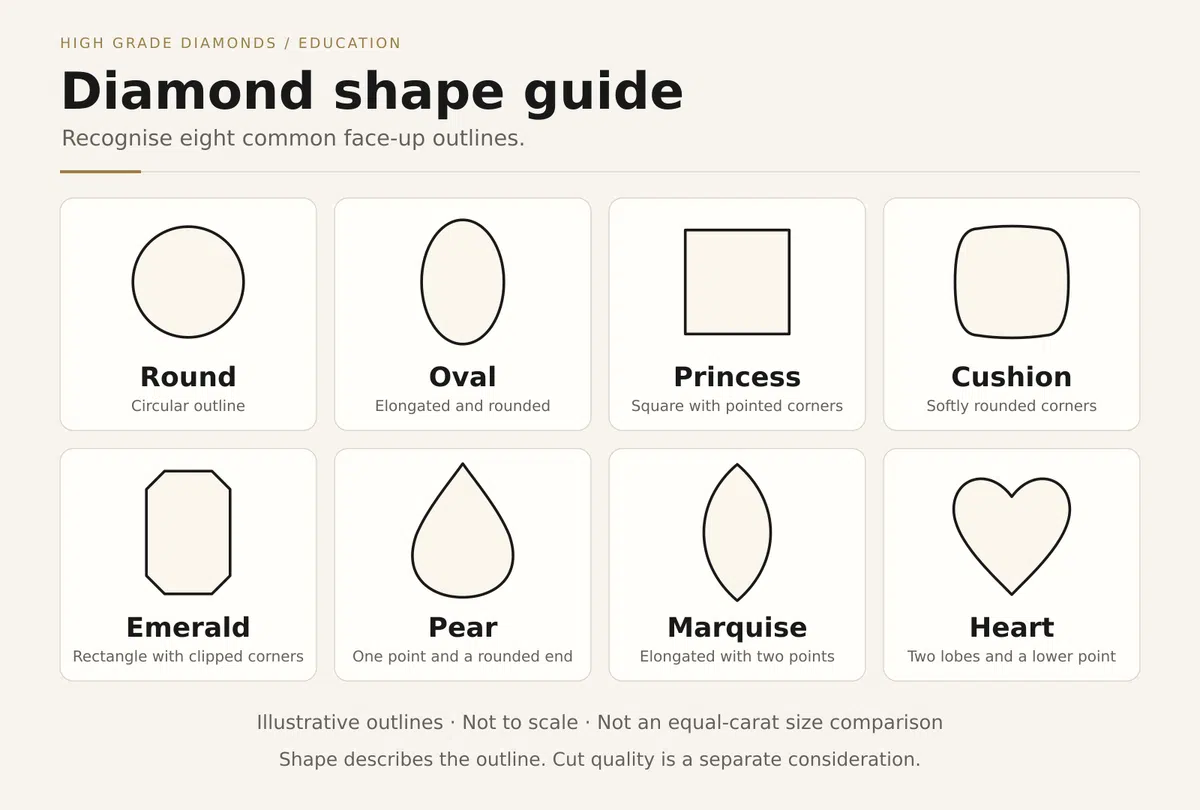
Find the outlines you like
Our diamond quote form includes the following shape choices. Use this as a starting point, then look at actual diamonds and ring designs to narrow your favorites.
| Shape | A starting point for your preference |
|---|---|
| Round | A circular outline with brilliant-style facets. |
| Oval | An elongated, rounded outline; compare fuller and slimmer proportions. |
| Emerald | A rectangular outline with clipped corners and step facets. |
| Pear | A rounded end tapering to a point. |
| Radiant | Clipped corners and brilliant-style faceting. |
| Marquise | A long outline with two pointed ends. |
| Cushion (square) | A squarer outline with rounded corners. |
| Cushion (long) | An elongated version of the rounded cushion outline. |
| Princess | A typically square outline with pointed corners. |
| Heart | A heart-shaped outline with a cleft and pointed tip. |
| Asscher | A square outline with clipped corners and step facets. |
Shape and sparkle are different choices
Shape describes the outline; cutting style describes the arrangement of facets. Step-cut diamonds such as emerald and Asscher have broad, geometric reflections. Brilliant-style cuts have a busier pattern of sparkle. GIA’s shape guide explains these differences.
You can like an outline and still prefer one individual diamond over another. A reference photo helps us understand the style you want; the video in your quote helps you assess the particular stone we propose.
Use dimensions to describe your preference
Carat is weight, so compare the diamond's measurements in millimeters as well. Read GIA’s explanation of carat weight. For an elongated shape, length-to-width ratio is another useful way to describe the outline.
Divide length by width: a hypothetical 9.0 × 6.0 mm diamond has a ratio of 1.50. At the same length, a wider stone has a lower ratio. This number describes proportions; it does not tell you whether you will prefer the diamond.
Add a preferred ratio or dimensions to your quote notes if you have them. If you do not, descriptions such as “a fuller oval” or “a long cushion” give us a useful direction.
Review the exact diamond in motion
Every diamond quote includes an HD video of the exact stone, its official grading report and pricing. We do not substitute stock videos for the diamond you would receive.
Watch the outline, reflections and contrast as the stone moves. Ovals can show a darker band across the center, often called a bow-tie; its visibility varies between stones and with viewing conditions. GIA’s oval guide discusses what to look for.
Tell us what you like and what distracts you. That feedback helps us understand whether an alternative diamond would better suit your preferences.
Bring the shape and setting together
Use the center-stone shape filter in our ring collection to explore relevant designs. Open a product to choose white gold, yellow gold, rose gold or platinum, your metal purity and ring size. Then select a natural or lab-grown center diamond and share your preferred size, clarity and color.
The photographs show the semi-mount setting. When you select a center diamond in the builder, we can supply it as a complete ring, including that diamond. The product page keeps those choices together in one quote request.
The setting also needs to suit the stone's outline. For example, a pear's point benefits from protection such as a V-shaped prong or bezel. GIA explains pear-shaped settings. Use Additional notes to tell us about a preferred orientation, prong style or other design detail you would like us to consider.
Keep the finished ring in mind
Share your budget for the complete ring so we can consider the diamond and setting together. Mention whether natural origin, a particular shape, the center stone's appearance or a specific setting is your priority.
If your ideal combination is not shown in the collection, use our custom jewelry form. You can upload inspiration photos, add a reference link and describe the design you would like us to create.
Already have your center stone?
We also offer settings on their own. Select Setting only (no center stone) and share your stone's exact length, width and depth in millimeters. We can tailor the setting to those measurements, including pre-notched prongs for a suitable prong-set design. Our semi-mount guide explains this option.
Turn your shortlist into a ring
Find a ring design you love and personalize it, or request a loose diamond quote if you want to begin with the stone. High Grade Diamonds can help you move from a preferred shape to the complete ring.